
A trustworthy alarm servicing company in Adelaide should hold a current South Australian Security Agent Licence issued by Consumer and Business Services, be a member of the security industry body ASIAL, carry appropriate insurances, and ensure all staff are trained, police‑checked, and individually licensed. They should also comply with relevant Australian Standards and provide transparent, upfront quotes before starting any service work.
Key takeaways
- A South Australian security agent licence is a legal requirement, not a marketing claim
- Service pricing should be transparent before any work begins
- Monitoring contracts and service work should be separate decisions
- A competent service call includes a battery load test, walk-test of all sensors, and a written report
- An honest installer will tell you when a system is genuinely too old to repair
Contents
- 1 You’re right to be cautious
- 2 Why “who to trust” is a fair question in this industry
- 3 Seven things to check before you trust an alarm servicing company
- 3.1 1. Do they hold a current South Australian security agent licence?
- 3.2 2. Are they an ASIAL member or hold equivalent industry accreditation?
- 3.3 3. Do they service the brand you already own?
- 3.4 4. Do they quote service work transparently before starting?
- 3.5 5. Do they pressure you into a monitoring contract?
- 3.6 6. Do they keep records and can they re-attend the same job?
- 3.7 7. Are they upfront about when a system is genuinely too old to repair?
- 4 Repair or replace? A decision table
- 5 Questions to ask before you book a service call
- 6 What does a proper alarm service call include?
- 7 How Blu Sky approaches alarm servicing in Adelaide
- 8 Alarm servicing terms explained
- 9 Frequently asked questions
- 9.1 How much does an alarm service call cost in Adelaide?
- 9.2 Do I need to keep using the company that installed my alarm?
- 9.3 Can any electrician service an alarm system?
- 9.4 What happens if my alarm installer has gone out of business?
- 9.5 Is it cheaper to repair or replace an old alarm system?
- 9.6 How often should an alarm system be serviced?
- 10 Trust is earned on the day
You’re right to be cautious
If you are reading this, you probably have an alarm system that you no longer trust. Maybe the company that installed it has gone quiet, retired, or been bought out. Maybe your keypad is beeping and the last technician couldn’t fix it. Maybe you have inherited a system from the previous owners with no manual, no codes, and no idea who to ring.
When you start contacting alarm companies, they all sound confident – and quotes can vary widely without a clear reason why. This article cuts through the noise, outlining what a trustworthy alarm servicing company in Adelaide looks like, the questions to ask before booking, and how to spot the difference between genuine advice and an unnecessary system upgrade.
Why “who to trust” is a fair question in this industry
Security work in South Australia is regulated. Under the Security and Investigation Industry Act 1995, administered by Consumer and Business Services (CBS), anyone who installs or maintains alarm systems for a fee must hold a security agent licence. That covers both the company and the individual technicians on your property.
Despite this licensing framework, the industry has a reputation problem. Some of that comes from companies pushing unnecessary upgrades on customers who only needed a battery replaced. Some comes from high-pressure monitoring contracts that lock people in for years. And some, frankly, comes from unlicensed operators offering cash-only work who leave behind systems no licensed company wants to touch.
Servicing an existing alarm can be more demanding than installing a new one. The technician works on another security installer’s panel, often a brand they don’t usually install, sometimes 10+ years old, and has to diagnose it on the spot. That requires a real licence and real product knowledge.
Seven things to check before you trust an alarm servicing company
This is the practical part. You can apply this list to any company you are considering, including ours.
1. Do they hold a current South Australian security agent licence?
A security agent licence is the licence required in South Australia under the Security and Investigation Industry Act 1995 to install or maintain alarm systems for reward. It is not a marketing claim. It is a legal requirement, and you can verify it.
You can search a company name or technician name on cbs.sa.gov.au to confirm a current licence is held. If a company hesitates when you ask for their licence number, that is your answer.
2. Are they an ASIAL member or hold equivalent industry accreditation?
ASIAL (Australian Security Industry Association Limited) is the peak national body for the security industry. Its members are required to follow a Code of Professional Conduct and participate in a formal complaints and dispute resolution process if standards are not met.
Membership isn’t the only marker of a good installer, but it is a useful one. It signals that the company has elected to be held to a published standard.
3. Do they service the brand you already own?
Many Adelaide alarm systems include Bosch, DAS, DSC, Hills Reliance, NESS, Paradox, Risco, Inner Range, Tecom, Interlogix, Honeywell, Sierra and C&K. A trustworthy company will either confirm they can service your brand, or tell you upfront that they can’t and refer you elsewhere.
Be cautious of any installer who insists your system “can’t be serviced” without inspecting it. That is sometimes true for genuinely end-of-life panels, but it is also sometimes a sales tactic to push a full replacement.
4. Do they quote service work transparently before starting?
Before a technician sets foot on your property, you should know:
- The callout fee
- The labour rate after the callout fee, if its billed in 15 minute increments to keep the price optimised
- A reasonable estimate of likely parts costs (battery, keypad, sensor)
Walk away from anyone who refuses to discuss pricing until they have already opened your panel. That is not how a service business that respects its customers operates.
5. Do they pressure you into a monitoring contract?
Back-to-base monitoring is a service where alarm signals are sent to a 24/7 monitoring centre that can dispatch a response. It is genuinely valuable for many homes and businesses, and a lot of our customers use it.
What it should never be is a precondition of a service call. A trustworthy company will fix your existing alarm, talk to you aboutmonitoring on its merits, and let you decide separately. If a company won’t work on your system unless you sign a multi‑year monitoring agreement, that tells you exactly whose interests they’re prioritising
6. Do they keep records and can they re-attend the same job?
Look for a company that documents what they did, what they used, and what they recommended next. If you ring back in six months because the same fault has returned, the next technician should be able to read the file and pick up where the last visit left off, not start the diagnosis from scratch on your time.
This sounds like a small thing. It is actually one of the biggest indicators of a properly run service business.
7. Are they upfront about when a system is genuinely too old to repair?
There is a point at which fixing an old alarm panel costs more than replacing it. A trustworthy installer will tell you that honestly, give you both the repair and the replacement quotes, and let you choose. They will not pretend the repair is impossible to force the upgrade, and they will not sink your money into a panel that is two service calls away from being end-of-life anyway.
If you would like a structured way to think about that decision, the next section is for you. (And if a replacement is genuinely the right call, our alarm system upgrade page walks through what is involved.)
Repair or replace? A decision table
| Factor | Repair makes sense when… | Replacement makes sense when… |
| System age | Under 10 years | Over 15 years |
| Parts availability | Manufacturer still supports the panel | Panel is end-of-life or parts are scarce |
| Repair cost | Less than 30% of replacement cost | Approaching 50% or more of replacement cost |
| Mobile app and remote access | Existing system already supports it | System cannot support modern app integration |
| Compliance | Meets current requirements for your property | Falls short of current standards (e.g. rental smoke alarm rules) |
| Sensor coverage | Existing layout still suits the property | Renovations or extensions have left gaps |
This is a guide, not a rule. A 12-year-old Bosch panel in good condition with available parts and a layout that still suits the home is often worth servicing. A six-year-old budget system with discontinued sensors and no app support sometimes isn’t.
Questions to ask before you book a service call
Use these on the phone. Any reputable Adelaide alarm company will answer them without hesitation.
- Are you licensed by CBS for security agent work in South Australia? What is your licence number?
- Do you have a callout fee, and is it deducted if the work goes ahead?
- What is your labour rate after the call out?
- Do you service any alarm brand panels and keypads?
- Can you replace the backup battery and test the system in the same visit?
- Do you provide a written report after the service call?
If you get a clear, calm answer to all six, you have probably found the right company. If the answers feel evasive, ring the next one on your list.
What does a proper alarm service call include?

A competent service call is more than a battery swap. The Australian standard for intruder alarm systems, AS/NZS 2201.1:2007, sets out what a properly maintained system should look like. In practice, a proper service visit covers:
- Inspection of the control panel, including fault history and event log
- A backup battery load test
- A walk-test of every sensor, where the technician walks past each motion sensor (PIR), reed switch, duress sensor, etc to confirm it is detecting and reporting correctly
- Testing of the communication path, including Mobile, IP, or dual-path (an alarm signalling configuration that uses two communication paths so a single failure does not disable monitoring)
- Inspecting logs, clearing trouble conditions
- Updating firmware where appropriate
- Auditing user codes
- Wiping keypads, sensors, removing cobwebs.
- A written summary of what was done, what was replaced, and what is recommended next
From the workshop: In our experience servicing Adelaide alarm systems, the single most common cause of a system fault is a flat backup battery, often after 3 to 5 years of service. The second most common is a sensor that has been disabled or faulted out at some point and never reset, leaving a part of the home unmonitored without the owner realising. Both are quick fixes for a licensed technician, and neither requires a full system replacement.
How Blu Sky approaches alarm servicing in Adelaide
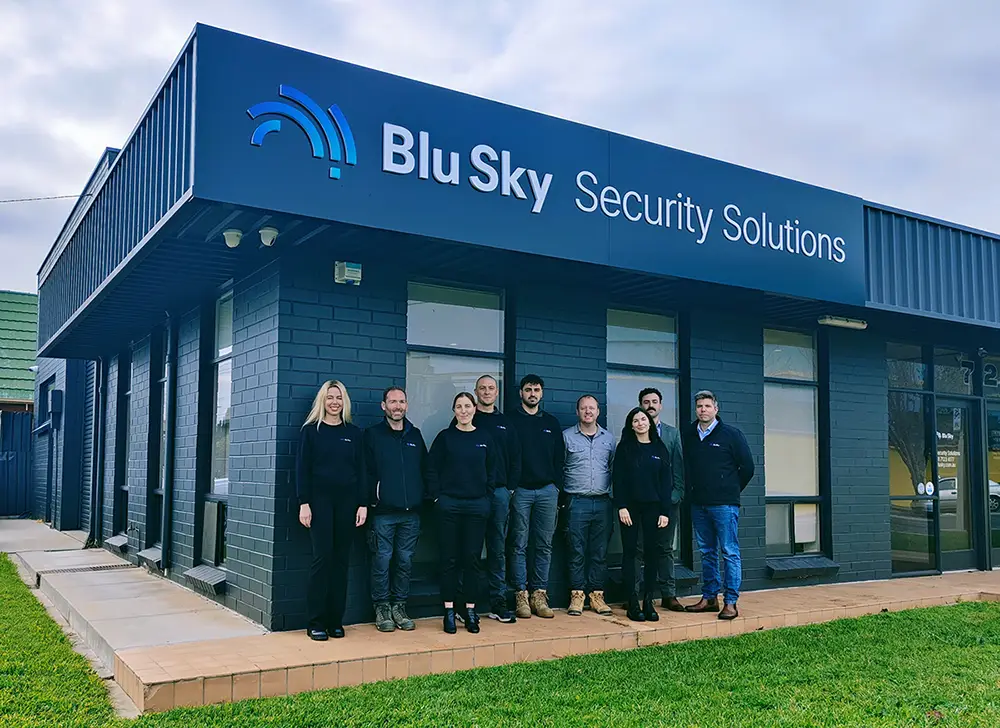
Blu Sky Security Systems is licensed in South Australia (CBS security agent licence number: ISL 266949) and an ASIAL member. Our technicians are based in Adelaide and service all major alarm brands, including Alarm.com, Bosch, DAS, DSC, Hills Reliance, NESS, Paradox, Risco, Inner Range, Tecom, Interlogix, Honeywell, Sierra and C&K.
A few things we hold to:
- We will quote a callout fee, additional labour in 15 minute increments, and likely parts costs before we attend.
- We service alarm systems whether or not you take monitoring with us.
- We provide a written summary at the end of every service visit.
- If your system has reached end of life, we will tell you, and we will give you both the repair and the replacement quote so you can decide.
For ongoing peace of mind, our Maintenance Program covers an annual service visit, priority response, and battery checks at a fixed yearly cost. If you would prefer to book a one-off visit, you can book a service call online or phone us directly.
We service the Adelaide metropolitan area and the Adelaide Hills.
Alarm servicing terms explained
- Security agent licence: The licence required in South Australia under the Security and Investigation Industry Act 1995 to install or maintain alarm systems for reward.
- Back-to-base monitoring: A service where alarm signals are sent to a 24/7 monitoring centre that can dispatch a response.
- Walk-test: A diagnostic procedure where a technician walks past every motion sensor to confirm it is detecting and reporting correctly.
- Dual-path communication: An alarm signalling configuration that uses two communication paths (typically Mobile Cellular and IP) so a single failure does not disable monitoring.
- PIR sensor: Passive infrared sensor; the most common motion sensor in alarm systems.
- End-of-life panel: A control panel the manufacturer no longer supports with parts or firmware updates.
- Callout fee: A fixed charge to attend the property, typically credited against the labour cost if work proceeds.
- ASIAL: Australian Security Industry Association Limited, the peak national body for the security industry.
Frequently asked questions
How much does an alarm service call cost in Adelaide?
Most alarm service calls in Adelaide are charged as a callout fee plus an hourly labour rate, with parts (commonly a backup battery, around $40 to $80) charged separately. A typical service visit, including battery replacement and a full walk-test, takes about 1 hour. Always ask for the callout fee, hourly rate, and likely parts before booking.
Do I need to keep using the company that installed my alarm?
No. Any licensed security agent in South Australia can service most alarm systems, subject to brand familiarity. If your original installer has closed, retired, or stopped responding, you are free to engage a different licensed company. The system itself does not “belong” to the original installer.
Can any electrician service an alarm system?
No. An electrical licence does not authorise security work in South Australia. A security agent licence under the Security and Investigation Industry Act 1995 is required to install or maintain an alarm system for reward. An electrician without a security agent licence cannot legally service your alarm, even if they are technically capable of the work.
What happens if my alarm installer has gone out of business?
Your system itself will keep working. A new licensed installer can typically take over servicing if the panel. The new technician will need access to the panel and ideally any user codes or installer codes, but a competent technician can usually work around missing codes during a service visit.
Is it cheaper to repair or replace an old alarm system?
As a general guide, repair is sensible when the system is under 10 years old, parts are still available, and the repair cost is less than around 30% of the replacement cost. Replacement starts to make sense when the system is over 15 years old, parts are scarce, or the repair cost approaches 50% of replacement. The decision table earlier in this article sets out the full picture.
How often should an alarm system be serviced?
For most residential alarm systems, an annual service visit is appropriate. Backup batteries typically need replacement every 3 to 5 years, and a yearly walk-test catches faulted sensors before they become blind spots. Commercial sites, sites under insurance requirements, or properties with compliance obligations (such as rental properties) may need more frequent servicing.
Trust is earned on the day
The hard truth of this industry is that you cannot tell a trustworthy alarm company from a slick one by looking at their website. The difference shows up on the day, in the way the technician quotes the job, in whether they explain what they’re doing, in whether they leave you a written report, and in whether they tell you the truth about your system’s condition.
If you are weighing up who to call in Adelaide, we would be glad to be one of the companies you consider. You can book a service call online, or for urgent issues phone us on (08) 7123 4177.